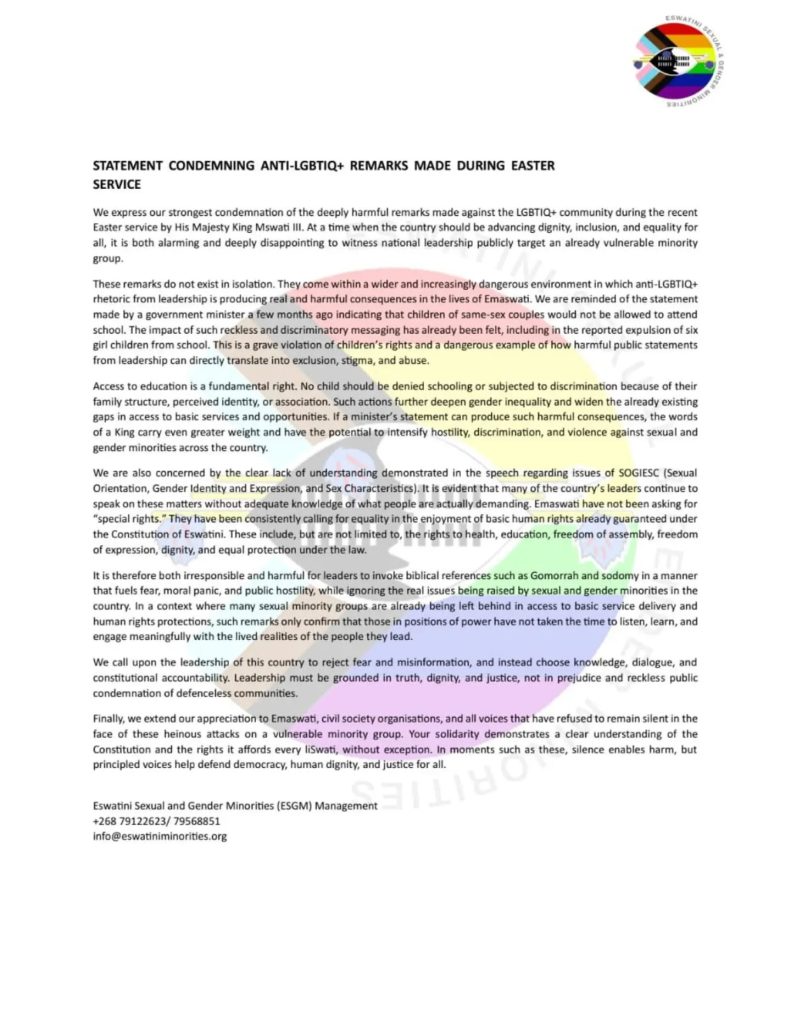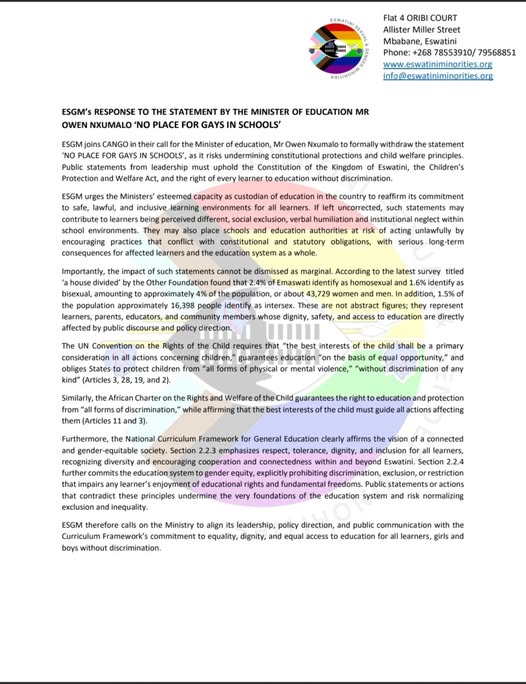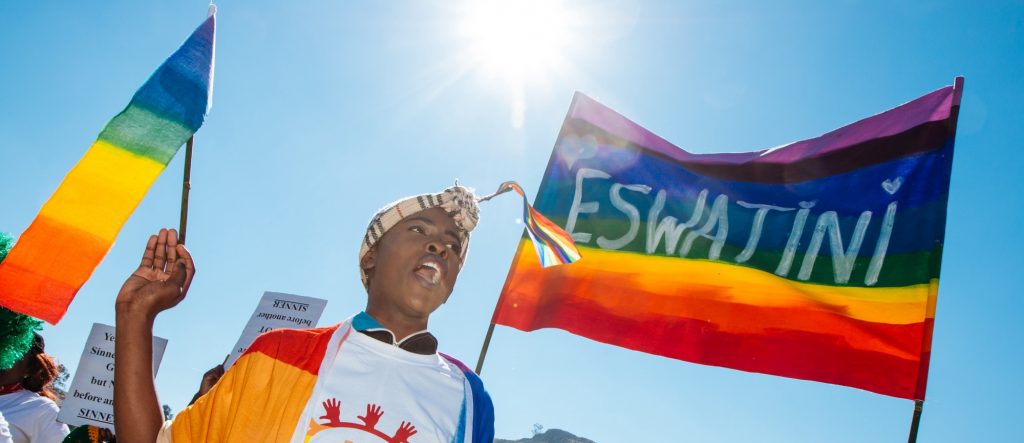
The Kingdom of Swaziland (eSwatini) continues to miss the boat by several rivers on issues relating to access to healthcare for the LGBTI. The country’s upper house in parliament, the Senate, has recently failed to see the importance of a debate on the lived experiences of each and every individual in the LGBTI community when going to a state hospital.

Introduction
Health is a fundamental human right grounded in human rights. Human rights are commonly understood as “inalienable fundamental rights to which a person is inherently entitled simply because they are a human being.” Human rights are thus conceived as universal (applicable everywhere) and egalitarian (the same for everyone). Because health is a fundamental human right, everyone should be able to access health care in the same way.
Health is a commodity that all humans should be able to enjoy in the amounts in which they all wish to have it. Because health is a commodity, factors will determine how humans demand it. Pecuniary, or financial, issues determine how individuals access health care. And there are also non-financial barriers to access to health care or determinants thereof; these include, but are not limited to, the following;
Geographic location, service availability, affordability and acceptability. Let us zero in on acceptability. Acceptability has globally been defined to include the following;
Acceptability
- Characteristics of the health services – Management/staff efficiency
- User’s attitudes and expectations – Technology
- Household expectations
- Community and cultural preferences, attitudes and norms
In designing health systems, it is therefore imperative to focus not only on the business side of the entity. Social issues also need to be factored into the equation to ensure every citizen receives the care they deserve. Imagine walking into a shop and getting racial stares or being met with a hostile attitude from the shopkeeper; what would your first impulse be? Would you still stay and shop there, or would you leave and shop elsewhere?
In some situations, a consumer has the right to vote with their feet and source the commodity elsewhere; however, with health care, we consume it because we are sick and need it to improve our health. If then one cannot access health care because of the attitudes of health care workers, then that is tantamount to telling that one person to die. Or is it that the government values one life less than another? A life is a life regardless.
Constitutional Protection for the LGBTI
The constitution of Swaziland does indeed make provision for the rights and freedoms of individuals, but when specifying protection across various axes of difference, sexual orientation (and gender identity) is blatantly excluded. One can argue that all individuals are protected, but without an explicit statement of which differences qualify for protection, personal views, preferences, and prejudices can be enforced as the constitution, making it very difficult to prove discrimination. This means the constitution’s provisions exist in theory, but without the will to apply them fairly, they might as well not exist.
When one is discriminated against, the constitution counts for very little in that moment because one can only take remedial action. When one has to call on structures for protection from an act already committed against them, the likelihood of encountering someone who shares the prejudiced views that enabled the injustice is high. The official has power to enable or retard the retributive process, and LGBTI people (and others) are often strangled by bureaucracy so they don’t bother to see the process through. The fact that practitioners are not sensitised to their duty to treat everyone fairly allows personal prejudice to operate undetected, in a society where prejudice towards difference is normalised at various levels.
To say that the LGBTI is asking for special treatment at the expense of others is a misinterpretation of the motion. When they are not getting fair treatment and are being discriminated against based on sexual orientation and gender identity, making special provisions in an unjust system is actually just equality.
The LGBTI in Swaziland is not considered with the same respect and fairness that other citizens are, and hence their experiences are trivialised. Under these conditions, the ability to access healthcare and treatment without fear of being denied treatment and victimisation is severely impaired. Provisions to curb this ensure that everyone gets the same service.
The point is not the intention, but rather the consequence. At the moment, good intentions see LGBTI people excluded; hence, more needs to be done to see them included, as are all other citizens.
LGBT Specific Health Issues
LGBT individuals encompass all races and ethnicities, religions, and social classes. Research suggests that LGBT individuals face health disparities linked to societal stigma, discrimination, and denial of their civil and human rights. Discrimination against LGBT persons has been associated with high rates of psychiatric disorders, substance abuse, and suicide. And if I value the economic and social costs of the above illnesses, refusing to provide some protection to LGBTI people in terms of access to health care will cost the country even more in impact mitigation.
Experiences of violence and victimisation are frequent for LGBT individuals and have long-lasting effects on the individual and the community. Personal, family, and social acceptance of sexual orientation and gender identity affects the mental health and personal safety of LGBT individuals.
Why LGBTI Health is Important
Eliminating LGBT health disparities and enhancing efforts to improve LGBT health are necessary to ensure that LGBT individuals can lead long, healthy lives. The many benefits of addressing health concerns and reducing disparities include:
- Reductions in disease transmission and progression
- Increased mental and physical well-being
- Reduced health care costs
- Increased longevity
The Honourable Senator Ngwenya was right to state that this will cost the country more in the medium to long term. Furthermore, she was justified in her argument that if Swaziland is really to win the fight against HIV, cancer, and other non-communicable diseases, there is a need to ensure effective investments in all population subgroups. Owing to the branching processes of diseases, that is, the process through which diseases get transmitted from one person to the next.
Let us make this hypothetical scenario: if a bisexual person has two partners, one gay and one straight, and the straight partner has HIV, for example, it gets transmitted through the bisexual person to a gay person, for example. And if a gay human being has another straight MSM partner, imagine the spread of the virus. By rejecting this motion, senators have left that conduit of transmission wide open, with no room for recourse.
The Research on LGBT Health and Trans Health
LGBT health requires specific attention from health care and public health professionals to address several disparities, including:
- LGBT youth are 2 to 3 times more likely to attempt suicide.
- LGBT youth are more likely to be homeless.
- Lesbians are less likely to get preventive services for cancer.
- Gay men are at higher risk of HIV and other STDs,
- Lesbians and bisexual females are more likely to be overweight or obese.
- Transgender individuals have a high prevalence of HIV/STDs, victimisation, mental health issues, and suicide and are less likely to have health insurance than heterosexual or LGBTI individuals.
- Elderly LGBT individuals face additional barriers to health because of isolation and a lack of social services and culturally competent providers.
- LGBTI populations have the highest rates of tobacco, alcohol, and other drug use.
It is therefore imperative that the health system be capacitated to deliver effective and efficient services to all population subgroups if we are to reach zero new HIV infections by 2022. If the country is to halt the spread of cancer and other non-communicable diseases truly, we must plan for all Swazis. Every life counts, and we must protect each and every life. No one has the right to play God; there is only one Judge, and that Judge is God. Our role as health care providers is to provide effective services to try to preserve every life.
Conclusion
Is the point about equality or equity? If a group of people have been denied access to certain services and had their rights disregarded, putting structures in place to correct that is not special treatment. Not giving that treatment to others isn’t discrimination because they already have it. This is equity.
A gap exists, and to close it, more needs to be done for those who have been disenfranchised so they can catch up to those who are fairly treated and properly protected. Only once equity has corrected the imbalance can equality be considered, with everyone starting from the same point.
First published on LGBTI Swaziland on 8 August 2017.
Media enquiries info@eswatiniminorities.org
More on statements and advocacy